
“There can’t be peace without justice, and there can’t be justice without the participation of women”, Diana Salcedo, Limpal Colombia
As Colombia approaches its ten-year anniversary of the signing of Colombia historic Peace Accord, key achievements are coming under increasing threat. The government of President Abelardo de la Espriella is pursuing policy changes and proposing budget cuts that risk undermining institutions responsible for peacebuilding and transitional justice. Its opposition to the 2016 Peace Accord, coupled with an increasingly militarised approach to security, threatens to reverse hard-won progress and place conflict-affected communities, particularly women, at greater risk.
These were among the key concerns raised at a London event on 15 October 2026, organised by ABColombia, Colombia Caravana, LIMPAL Colombia and 39 Essex Chambers, bringing together legal experts, human rights defenders and civil society representatives to examine the challenges facing peace and justice in Colombia’s new political context.
The event highlighted the importance of protecting Colombia’s transitional justice institutions, ensuring the meaningful participation of women and victims, and addressing the structural inequalities that have fuelled decades of armed conflict.
Widely regarded as a global landmark, Colombia’s 2016 Peace Accord was the first of its kind to include a gender perspective, recognising the disproportionate impact of conflict on women and LGBTQI+ people.
It also established a transitional justice system to deliver truth, justice and reparations to over 10,357,896 registered victims of the armed conflict victims. These mechanisms have enabled thousands of survivors, including people targeted because of their sexual orientation or gender identity, to have their experiences formally recognised and addressed.
Implementation of the 2016 Peace Accord is a state commitment that should not be undermined by changes of government. Full implementation has not been the central policy of any government since the Accord was signed, yet the peace process has achieved important changes. In November 2025, the Kroc Institute, which monitors implementation, reported that 36% of the Accord’s commitments had been fully implemented. More than 11,000 of the 13,000 former FARC combatants who demobilised remain in the peace process.
There is however still a long way to go there is today over 28,000 members of at least nine illegal armed and criminal groups active. More than 1,700 human rights defenders (HRDs) have been killed since the signing of the Peace Accord, and XXX former combatants. Despite this in areas most impacted by the conflict there remains a commitment to the full implementation of the Peace Accord, this is reflected in the geographical pattern of voting with communities on the Caribbean and Pacific coasts and in the south of the country.
Ten years of the Peace Accord: Achievements and unfinished commitments
Opening the discussion, Kirsty Brimelow KC reflected on the historic signing of the Peace Accord in September 2016, recalling the powerful symbolism of an agreement signed with a pen made from bullets, and people dressed in white, wearing badges in the shape of doves. She highlighted significant achievements over the past decade, including the disarmament of the FARC, the establishment of transitional justice institutions and the first restorative sentences issued by the Special Jurisdiction for Peace (Jurisdicción Especial para la Paz, JEP).
Drawing on her longstanding engagement with the Peace Community of San José de Apartadó, Brimelow illustrated the importance of translating formal commitments into meaningful changes for communities affected by conflict. She recalled the 2013 public apology issued by former President Juan Manuel Santos following years of stigmatisation and violence against the community, while emphasising that acknowledgement must be accompanied by accountability and guarantees of protection.
Her message was clear, the success of the Peace Accord must ultimately be measured by whether communities can live safely, access justice and exercise their rights without fear.
Women’s participation is essential to achieving justice
Diana Salcedo, Director of LIMPAL Colombia (WILPF Colombia), emphasised that peace and justice cannot be achieved without the meaningful participation of women.
Victim participation has been central to the JEP’s work. Through its macro-cases, victims have been able to participate throughout the process as rights-holders entitled to truth, justice, reparation and guarantees of non-repetition. This participation is also central to the JEP’s restorative justice approach, which seeks to ensure that those responsible for the most serious crimes contribute to repairing the harm caused.
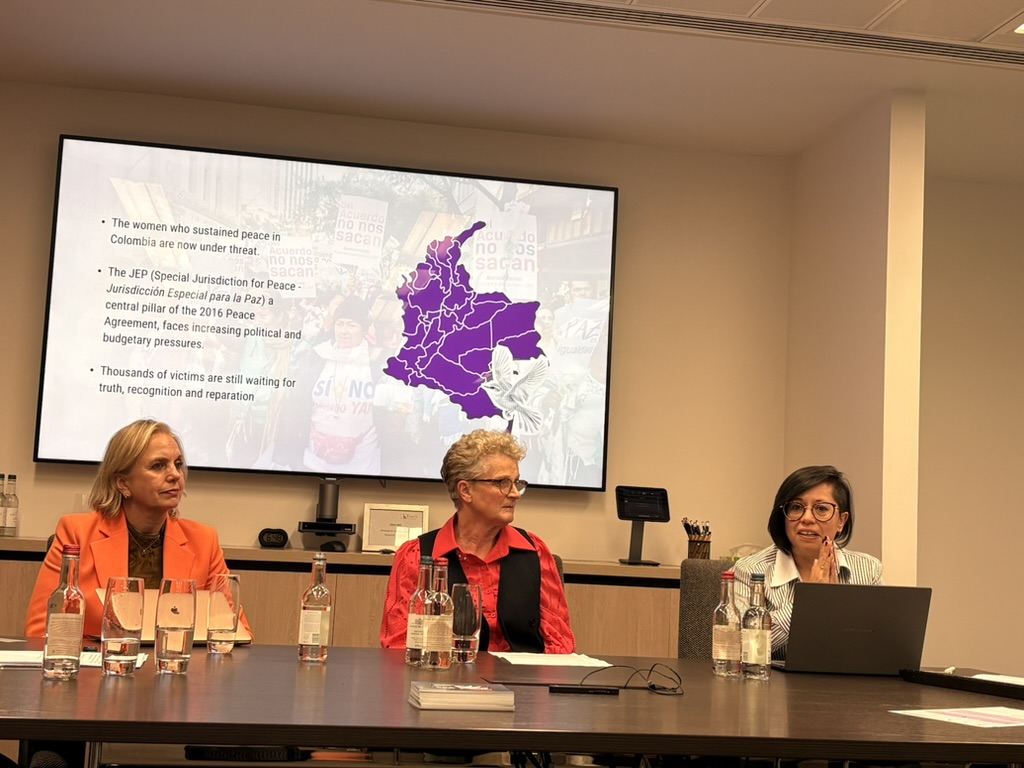
Diana underlined the JEP’s groundbreaking contribution to recognising the differentiated impacts of Colombia’s armed conflict on women and incorporating gender and intersectional perspectives across the different macro-cases, including those investigating kidnappings, extrajudicial executions (false positives), forced recruitment and the forced recruitment and use of children. She emphasised the role of macro-Case 11, which examines sexual and gender-based violence committed by all sides in the context of the armed conflict. As the last macro-case to be opened, seven years into the JEP’s mandate, macro-Case 11 faces a shorter timeframe to complete its investigations and deliver justice to victims. A recent legislative proposal to shorten the JEP’s mandate to ten years, rather than the existing 15-year framework with the possibility of a five-year extension, could further jeopardise its ability to fulfil its mandate.
Salcedo stressed that sexual violence during the conflict was not simply incidental but closely connected to structures of power and control. Addressing these violations requires recognising women’s experiences and ensuring that victims can participate safely, with appropriate confidentiality and protection from stigma.
She warned that attempts to weaken or discredit the JEP risk undermining victims’ confidence in the justice system and discouraging women from coming forward.
The gap between rights on paper and the reality on the ground
Katherine Barnes, a barrister at 39 Essex Chambers representing Colombia Caravana, shared findings from the organisation’s recent visit to Colombia, highlighting the gap between legal protections on paper and the realities faced by communities affected by conflict. In regions such as Catatumbo, Chocó, La Guajira and Casanare, armed groups continue to exercise territorial control, while the limited presence of the State leaves communities exposed to violence, forced displacement and serious barriers to accessing justice. In Catatumbo alone, more than 114,000 people had been forcibly displaced since January 2025, according to UNHCR figures reported in January 2026.
Barnes highlighted the particular challenges facing Indigenous and Afro-Colombian communities in regions severely affected by violence, as armed groups compete for territorial control. In Chocó, for example, illegal mining and the presence of armed groups continue to threaten communities and undermine their control over their territories. In La Guajira, where armed groups also compete for territorial control, the environmental and social impacts of coal mining have raised serious concerns. Despite numerous court rulings against the Cerrejón coal mine, owned by multinational mining company Glencore, compliance with these rulings remains seriously inadequate, illustrating the persistent gap between judicial decisions and their enforcement.
Ten years on: Threats to peace efforts
Louise Winstanley, Programme and Advocacy Manager at ABColombia, examined the implications of Colombia’s new political context following the inauguration of President Abelardo de la Espriella in August 2026.
De la Espriella was elected on a platform of an iron fisted militarised approach to security, including the fight against drug trafficking and fiscal austerity. However, his mandate was only supported by half of the population as he was elected with a less than one percent majority. Indicating that he needed to temper his policies and aim to reduce the polarisation.
While recognising the serious security challenges facing Colombia, she warned that an exclusively militarised response would fail to address the underlying causes of violence and could place civilian populations at greater risk.
She emphasised the need for a human security approach that addresses communities’ safety, rights and livelihoods. Any security strategy, she argued, must include state institutions and services, access to land and territory, economically viable and sustainable projects, political participation and local infrastructure. These priorities require full implementation of the PDETs, the local development projects agreed under the Peace Accord for the areas most affected by conflict. She noted that a purely militarised approach had not worked historically in Colombia and that government pressure for results had frequently led to human rights violations and crimes against humanity.
Rural reform remains particularly important for women, Indigenous Peoples, Afro-Colombian communities and small-scale farmers, who have historically experienced disproportionate exclusion from land ownership and economic opportunities. She highlighted several concerning developments: the ending of all dialogue processes that had been ongoing when the government changed, severe budget cuts to the Reintegration Unit (ARN, its Spanish acronym), and the replacement of the High Commissioner for Peace with the High Commissioner for Security. She expressed particular concern about proposed budget cuts to the Special Jurisdiction for Peace and the Unit for the Search for Persons Deemed Missing (Unidad de Búsqueda de Personas dadas por Desaparecidas, UBPD). She warned that the proposed UBPD cut was likely to result in a 50% reduction in its forensic units. These institutions play vital roles in establishing the truth, ensuring accountability and providing answers to families who have spent decades searching for disappeared relatives.
Winstanley also discussed a proposed Anti-Terrorism Statute that would establish a national register of terrorist organisations and actors. She warned that expansive definitions of terrorism elsewhere had affected civil society organisations. Taken together with changes to regulations governing public protest, she argued, the proposed statute could restrict civic space and create additional risks for civil society organisations and human rights defenders.
The UK’s responsibility to support lasting peace
As Colombia approaches the tenth anniversary of its Peace Accord, the discussion highlighted the importance of sustained international engagement.
The UK has played a significant role in supporting Colombia’s peace process, including through its position as penholder on Colombia at the United Nations Security Council, leading negotiations on resolutions concerning the mandate of the United Nations Verification Mission in Colombia.
At a time when the future of transitional justice and peace implementation faces increasing uncertainty, continued UK political and financial support remains vital.This includes protecting the independence and effective functioning of transitional justice institutions, supporting CSOs organisations and engaging with human rights defenders in order to develop effective strategies for their protection, and promoting the full and comprehensive implementation of the Peace Accord.