
Peace with Nature in the Heart of the World – Sierra Nevada de Santa Marta
On 28 August 2024, then-President Gustavo Petro instructed the National Land Agency to acquire the remaining sacred and strategic lands between Indigenous territory and the Black Line under the Agrarian Reform policy, an initiative he called “Peace with Nature in the Heart of the World”.
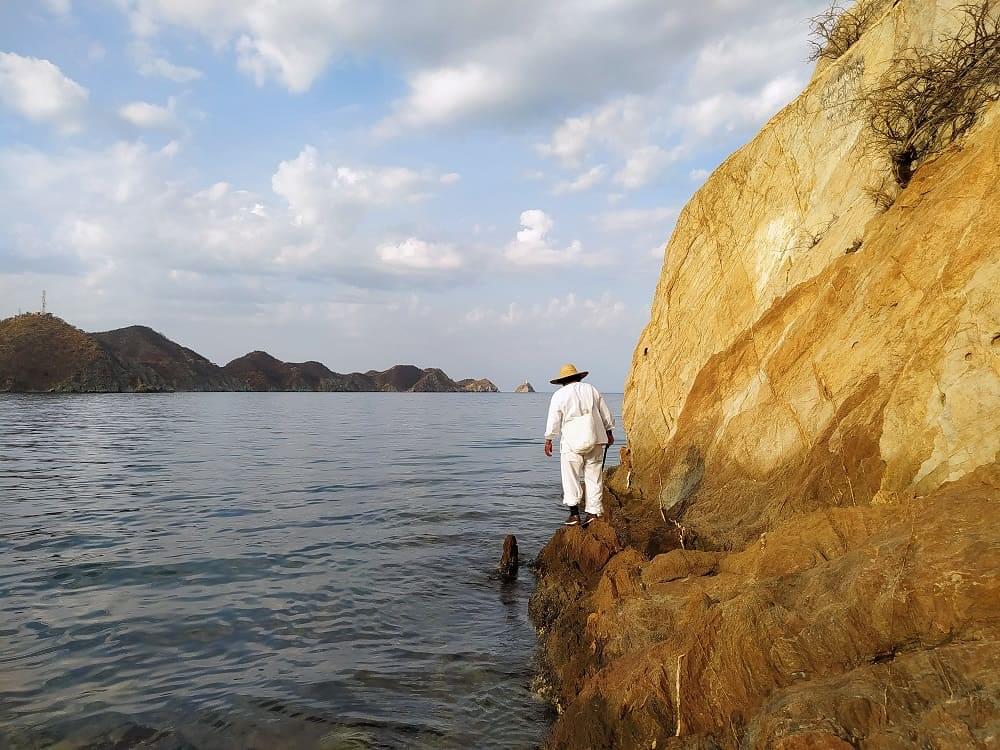
This came to fruition in 2026, as Petro was leaving office, when the National Land Agency formalised additional land titles for the Arhuaco, Kogui and Wiwa peoples—three of the four Indigenous peoples of the Sierra Nevada de Santa Marta – who, according to their traditions, live in the “Heart of the World”. The titles included Los Acantilados, a 227-hectare coastal strip linking the Indigenous Resguardo to the Caribbean Sea. The restored territory includes Hacienda Jirocasaca and Hacienda Anastacia in the Aracataca watershed. Recognised by the mamos of Seykumake and Numaka as sacred sites, the properties will be used for spiritual training and intercultural dialogue. They had previously been held in by the Society of Special Assets (SAE), after being confiscated from organised crime.
The recovered land is intended primarily for conservation and ceremonial practices that seek to harmonise the relationship between people and nature.
“This moment is historic for the Arhuaco people because we are recovering our relationship with the sea, which is essential for our ceremonies, for spiritual balance and for the protection of Mother Earth.” — Luis Enrique Salcedo Zalabata, Governor of the Arhuaco Cabildo[1]
The Amazon
On 4 August 2026, the Ministry of the Environment enacted Resolution 0961 of 4 August 2026, designating the Colombian Amazon biome as a permanent reserve for renewable natural resources and the environment. Covering 483,283 km², the reserve encompasses the entire Amazon region, which accounts for 42% of national territory. It prohibits new mining, oil or gas concessions. The Resolution was adopted following consultation with the region’s Indigenous peoples.
Resolution 0961 aims to protect the Amazon’s ecological integrity and “the physical, cultural and spiritual survival of the peoples who inhabit it, as well as to prevent serious and irreversible damage to biodiversity, water, the communities living there, ecological connectivity, water and climate regulation, ecosystem services, human rights and territorial rights”.[2]
LINGO, the Leaving in the Ground Initiative, estimates that “[nearly a billion tons of] potential CO2 pollution will stay in the ground as a consequence of the resolution. Over half of this number, 545 million tons, are from fossil fuels possibly recoverable now or in the near future. This means the decree has immediate climate benefits as it locks away fossil fuels that could realistically be extracted in the near- to mid-term”. Around 38% of the area containing Colombia’s oil and gas deposits overlaps with the newly protected zone.
However, there are exceptions. Mining projects with a mining title, an approved technical mining document and a valid environmental permit may continue operating until the end of their contractual term, but that term cannot be extended. Certain mining formalisation processes that predate the Resolution may also proceed through the procedures required to obtain a licence or environmental authorisation. These include special and differential concession contracts, declared Special Reserve Areas, and legalisation applications already being processed, all of which predate the Resolution.
Under the Resolution, Indigenous, Afro-Colombian and peasant communities may use renewable resources within their territories. It will not affect collective land-titling processes or the establishment of peasant reserve areas, and it will respect these communities’ powers over environmental matters and land-use planning.
According to La Silla Vacía, its reporters spoke ahead of the elections with the official responsible for Abelardo de la Espriella’s environmental policy, as set out in the ABC Plan, as well as with other associates. They said they would not promote mining, hydrocarbon extraction or fracking in the Amazon. However, the new Minister of the Environment, Fabio Arjona, reportedly disagreed with aspects of the Resolution, arguing that it would further increase illegal activity in the Amazon region. By contrast, he said the new government would undertake such activities legally, in unencumbered territories and perhaps in the Amazonian foothills: “But certainly not in protected areas or those of high environmental sensitivity. And almost the entire Amazon is of high environmental sensitivity.”
The Resolution is an important step towards safeguarding the planet and addressing the climate crisis. Colombia needs international support to ensure that this Resolution is fully enforced. Furthermore, the Colombian government and local communities should receive the financial assistance required to avoid bearing the economic costs of actions that deliver global benefits.
[1] Unofficial translation into Spanish
[2] Unofficial translation into Spanish