
Ten years after the signing of Colombia’s landmark 2016 Peace Accord, the country’s LGBTQI+ communities face growing concerns about the future of their rights and access to justice. During an advocacy visit to London from 26–29 October 2026, Colombia Diversa highlighted both the progress made through the peace process and the risks that the current political backlash poses to these achievements.
As part of an advocacy tour to Ireland and the United Kingdom, organised by Christian Aid, Colombia Diversa and ABColombia, representatives met with FCDO officials from the Conflict Policy and Partnerships team and Lord Collins, the UK Special Envoy for LGBTQI+ Rights. Discussions focused on the rollback of gender and LGBTQI+ rights and the threats this poses to hard-won gains in LGBTQI+ rights in Colombia. FCDO officials also expressed continued support for the full implementation of the Peace Accord. As Penholder of the UN Security Council Mission of Verification in Colombia, the UK has a particular role to play in sustaining international support for the Accord and ensuring that the gender perspective remains central to its implementation.
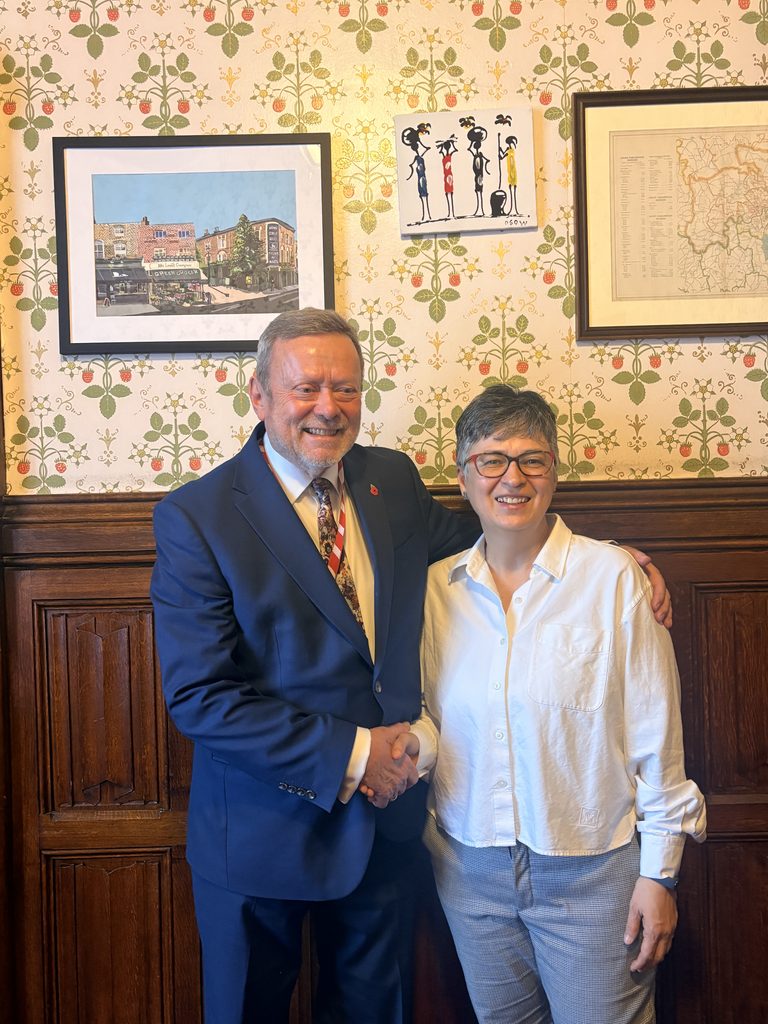
Lord Collins, UK Special Envoy for LGBTQI+ Rights and Marcela Sanchez, Colombia Diversa, at the House of Lords
On 28 October 2026, ABColombia held an event to mark the tenth anniversary of Colombia’s historic 2016 Peace Accord, co-organised with the All-Party Parliamentary Human Rights Group, the British Group of the Inter-Parliamentary Union (BGIPU) and Justice for Colombia. Chaired by Fabian Hamilton MP, the jam-packed event brought together former Colombian President and Nobel Peace Prize laureate Juan Manueal Santos; Harriet Thompson, director of the Americas at the FCDO; Louise Winstanley, ABColombia programme and advocacy manager; Marcela Sanchez, Executive Director of Colombia Diversa; Diego Martinez, legal adviser for the FARC during the 2012-2016 peace negotiations; and Mariela Kohon, Justice for Colombia’s vice-Chair.
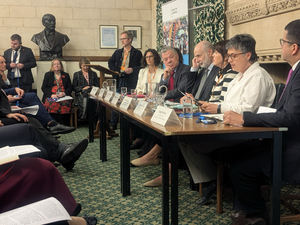
Parliamentarians, government officials, representatives from the diplomatic community and civil society joined them to celebrate this landmark achievement and reaffirm the urgent need for its full implementation. Santos praised the UK Government and the wider international community for their support for peacebuilding in Colombia, while highlighting the need to focus on the full implementation of core elements of the Accord. Marcela spoke about the Accord’s pioneering gender perspective and its recognition of LGBTQI+ people as victims of the armed conflict and as rights holders. This inclusion reflects years of advocacy by women’s and LGBTQI+ movements to ensure that their experiences, voices and rights are central to building peace.
Colombia Diversa also participated at an event organised by the Gender Action Network at King’s College London, in a conversation with Dr. Saskia Zielińska, Lecturer in Gender and Development. Louise Winstanley of ABColombia delivered the opening remarks explaining what had happened in the first ten weeks of the De La Espriella Government. The discussion explored what Colombia’s changing political landscape means for LGBTQI+ people and human rights defenders, and the transformative potential of transitional justice.
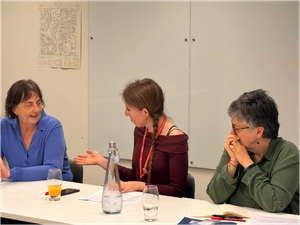
Louise Winstanley, ABColombia, programme and advocacy manager, Dr. Saskia Sielińska, lecturer in gender and development, KCL University, and Marcela Sanchez, Colombia Diversa
Hard-won rights under pressure
Colombia is widely recognised as one of the most progressive countries in Latin America in terms of its legal recognition and protection of LGBTQI+ rights. Over the past two decades, landmark Constitutional Court rulings and legislative reforms have advanced gender equality, including the recognition of same-sex marriage, adoption rights for same-sex couples, and legal protections for transgender people. Colombia’s 2016 Peace Accord was also ground-breaking in explicitly recognising LGBTQI+ people.
Many of these advancements are increasingly vulnerable to rollback. In September 2026, Colombia left the Equal Rights Coalition, an international coalition promoting the rights of LGBTQI+ people, at a time when it was sharing the presidency with Spain. Soon after, the government formally joined the Geneva Consensus Declaration, an international statement opposing reproductive rights for women and asserting that abortion is not an international legal obligation. Although this does not change Colombian law, it sends a damaging signal for gender equality.
At the King’s College public event, the discussion also covered the Colombian government’s removal of exhibits relating to LGBTQI+ rights, feminist movements, and certain aspects of the history of the armed conflict and peace processes from the National Museum in Bogotá. These removals appear to be part of an emerging culture war and the current government’s efforts to erase certain aspects of the country’s history. Following a legal challenge brought by civil society organisations, a judge ordered the exhibits’ reinstatement.
Although the exhibits were restored, their removal sent a troubling signal. For communities whose experiences have long been excluded, removing these pieces is part of a strategy to making those communities invisible once again.
Recognition, justice and reparations
Colombia’s 2016 Peace Accord broke new ground through its gender perspective, recognising the specific impacts of the armed conflict on women and LGBTQI+ people. It created opportunities for survivors to have their experiences acknowledged and to seek truth, justice, reparations and guarantees of non-repetition.
Colombia Diversa has played an important role in making these commitments meaningful. Through documenting conflict-related violence, supporting victims and advocating for accountability, the organisation has helped expose persecution based on sexual orientation and gender identity, including sexual violence, forced displacement and threats.
It currently accompanies around 150 victims participating in Macro-Case 11 of the Special Jurisdiction for Peace (JEP), which investigates conflict-related sexual and gender-based violence. This macro-case offers an unprecedented opportunity to recognise these crimes, establish responsibility and secure reparations that respond to survivors’ experiences.
Yet budget reductions threaten this progress. Weakening JEP’s capacity could deny justice to people who have already waited decades for redress. Sustained support for civil society organisations is therefore increasingly important, enabling them to continue accompanying victims in their pursuit of justice, documenting the harm they have experienced and helping them articulate what meaningful reparations would look like.
The accompaniment of victims and the work of the JEP have already born fruit. In some cases, many survivors who initially wanted perpetrators to be punished and rejected the prospect of dialogue have, over time, begun to reclaim their collective memory and considered what reparations could mean for them.
What do reparations look like? They will be different and depend on context and on the victims. They are not always costly. It is essential that they are meaningful if victims are to remain central in the restorative justice process.
What did one LGBTQI+ survivor ask for in reparation? That a senior military officer speak to his family and tell his parents that there was nothing wrong with his son. During the conflict even some parents went to the armed actors and asked them to make a “man” of their gay son. The constant reinforcement of toxic masculinity in the conflict led to atrocious acts against women and girls and LGBTQI+ persons in Colombia’s conflict.
Another account concerned a former member of the military who, through engaging with survivors, came to recognise gender diversity and the equal rights of LGBTQI+ people.
These experiences show transitional justice can also help repair relationships and rebuild the social fabric damaged by conflict.
International support remains essential
The Peace Accord has opened spaces for LGBTQI+ victims and women organisations to organise, build alliances and claim recognition as rights holders. Protecting those spaces requires sustained political commitment and adequate resources. With the Colombian government drastically reducing funding for implementation of the Peace Accord and the National Action Plan (NAP) 1325 on Women, Peace and Security, it is essential that resources reach local civil society organisations.
Without this support, peacebuilding efforts will be undermined, women and LGBTQI+ people will face greater risks, impunity will persist, victims’ rights will be weakened, and rural communities will be left without the accompaniment they need.
At the heart of this message is the recognition that sustainable peace must reach those who have historically been excluded. Colombia’s diversity is a strength for building that peace.
Read “The first 10 Weeks of De La Espriella government” for more analysis.